

Writing brand guidelines
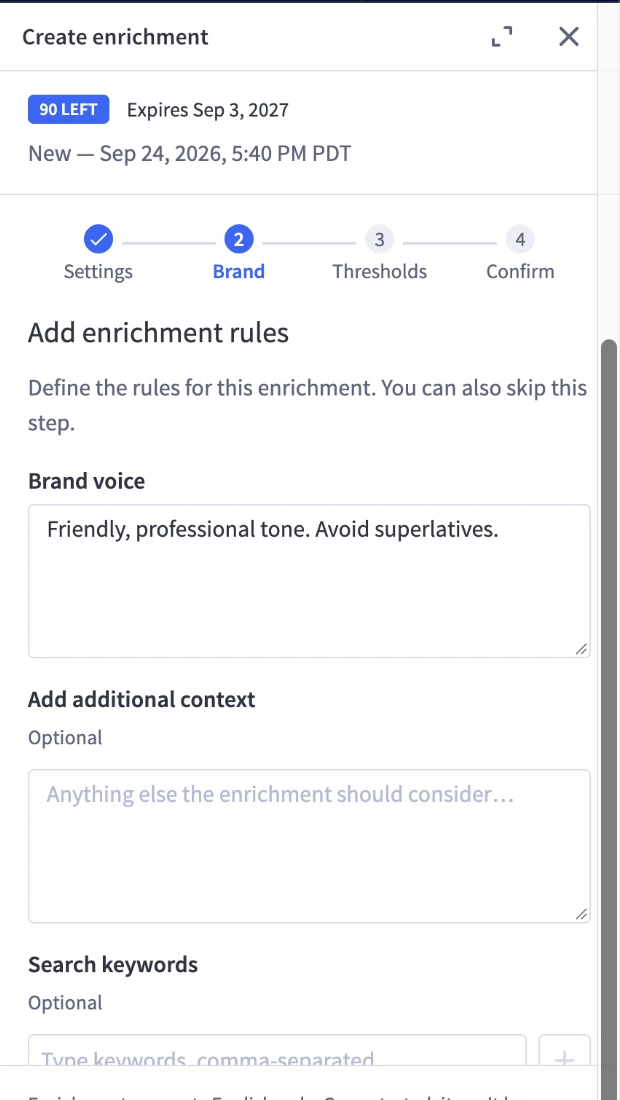
The support article asks for “your brand’s style guidelines.” This page covers what to actually write. It is the input with the largest effect on how output reads.
What to include
Work through these. A short paragraph or a few bullets each is enough.
Who you are. What you sell, who buys it, and what you want to be known for.
Personality. Three to five words. Technical, warm, irreverent, precise, understated. If two of your competitors could claim the same words, go further.
Tone by context. Descriptions might be warm and benefit-led while Q&A answers stay factual and short. Say so, because the fields are written separately.
Language and style. Formality, whether you address the reader as “you,” sentence length, and whether humour is appropriate.
Do’s and don’ts. The most directly useful section:
- Do: active voice, benefits before specifications, concrete nouns.
- Don’t: exclamation points, superlatives, filler phrases like “perfect for any occasion,” competitor names, emoji.
Restricted claims. Anything you cannot legally say — health claims, performance guarantees, certifications you don’t hold. List these explicitly.
Vocabulary. Words you always use and words you never use. “We say sofa, never couch” prevents a recurring correction across an entire category.
How specific to be
Specificity is the difference between usable output and generic output.
Keep it short
Specific does not mean long. Less is more here: a compact set of concrete rules is applied more consistently than several pages of prose, and it is far easier to revise between enrichments.
Aim for the shortest set of statements that would let someone unfamiliar with your store write one product description you would recognise, then stop. Long guidelines tend to repeat themselves and eventually contradict themselves, and a contradiction weakens every field it touches.
Where to source it
You do not need a formal brand book. Useful sources:
- A product page you are happy with — paste an excerpt and say “sound like this.”
- Your about page, for identity and values.
- A recent campaign brief, for tone.
- Your customer service macros, for how you already speak to buyers.
What to leave out
Anything that does not change how a sentence is written. Logo usage, colour palettes, print specifications, and company history take up space without affecting output.
Read your brand voice text and ask whether someone who had never seen your site could write one product description from it that you would recognise. If not, add the missing detail before running a batch.
Iterating
Brand voice is the input most worth refining between batches. Run 25 products, read the output, and note what you would change. Most of those notes turn into a do, a don’t, or a vocabulary rule. Then repeat the enrichment with the revised text.